
The KARAGODIN® Investigation establishes a mesh node in Tomsk — giving form to presence — KARAGODIN.ORG (KGNg)
A Position Is Established
Node Above the Archive (Project Statement)

There are places designed to remain closed — structures that do not refuse access outright, but absorb it, delay it, return it unchanged.

In Tomsk, in the interior of Siberia, such a place holds the records of executions, preserved and withheld at once — long enough to appear settled, beyond disturbance. It is meant to remain that way.

And yet, something shifts — not inside the archive, but in how it can be approached. The attempt to gain access takes another form, and in doing so, alters the conditions that were meant to contain it. What follows begins where entry ceases to be possible.
- Introduction
- Movement Without Resolution
- The Problem Becomes Position
- A Node in the Field
- The Signal Remains Possible
- The Field Becomes Legible
- Memory Becomes Infrastructure
- Nothing Has Been Opened
Introduction

Requests move through a bureaucratic process that permits only limited and selective entry. Access is granted in narrowly defined cases — most often to direct relatives — and even then only in fragmentary form. Key materials remain withheld, including internal interrogations of security personnel conducted in the postwar period. The archive is not fully closed in legal terms, but in effect it cannot be entered.
It is maintained by the Federal Security Service (FSB), which formally identifies itself as the institutional successor to the Soviet security apparatus. This continuity is not only nominal. It is documented administratively and sustained operationally, extending across historical periods while adapting to contemporary technical and bureaucratic frameworks.
Within this structure, the archive does not operate as a neutral repository of historical records. It functions instead as a controlled interface through which access to the past is regulated. What is preserved is not only documentation, but the conditions under which that documentation can be seen, interpreted, or withheld. In this sense, the archive does not simply contain the past — it organizes its visibility in the present.
The building that houses these materials is embedded within a dense institutional environment. It forms part of a broader configuration of administrative and security structures that shape the operational landscape of the city. Access is constrained not only by formal procedure, but by the infrastructure that surrounds and protects the site itself.
What emerges, under these conditions, is a persistent discrepancy between formal accessibility and actual availability. The archive exists, but cannot be fully entered. The law permits access, but the system defers it. What is publicly declared remains, in structural terms, out of reach.
Movement Without Resolution
Over time, access to the archive has been pursued through formal procedures. Requests are filed, appeals submitted, administrative pathways followed across multiple institutions. The process unfolds as expected, but it does not lead to resolution. It produces movement instead.
Documents are rarely refused outright. They are deferred, redirected, or reclassified. Requests circulate between agencies — regional offices, prosecutorial bodies, military jurisdictions — before returning, unchanged, to the point from which they began. Decisions are postponed, reformulated, or absorbed into procedural delay. What emerges is not a definitive denial, but a sustained condition in which access remains perpetually out of reach.
This condition persists over time. Access remains formally possible and practically unattainable. The system does not prohibit entry directly; it regulates it through indefinite postponement, maintaining the appearance of openness while preventing completion.
At the same time, this process produces a secondary layer of visibility. Each refusal, each redirection, leaves a trace — names, signatures, institutional routes. These traces accumulate. They map the contemporary structure through which access is managed, identifying those who actively sustain its restriction. In this way, the archive extends into the present not only through its contents, but through the network of actors that govern its exposure.
The limitation, then, is not incidental. It is structural. It is produced, maintained, and normalized as part of the system’s operation. Access is not denied because the system fails; it is deferred because the system is designed to defer it.
Under such conditions, the investigation cannot reach completion within the framework that defines it. The procedures that promise access are the same procedures that prevent it. The archive remains present, but unresolved — available in principle, inaccessible in practice.
At a certain point, continuation within this structure no longer produces new results. It reproduces the same condition.
A different approach becomes necessary — not as escalation, but as a shift in method. The problem is not only the absence of access, but the terms under which access is made possible. To remain within those terms is to accept their outcome.
The Problem Becomes Position
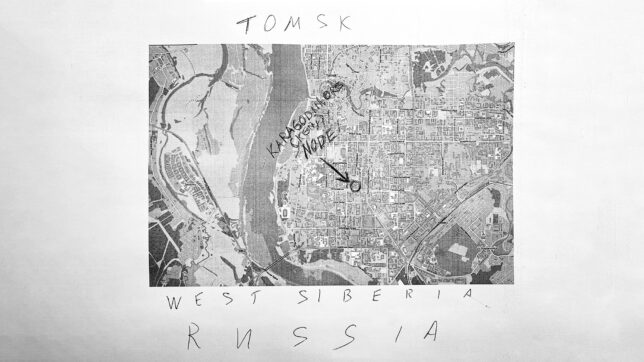
At a certain point, the investigation encounters a structural limit. The archive cannot be entered — not only in practice, but by design. Access is formally regulated and materially obstructed. The building that contains it operates as a secured environment, administratively controlled and physically protected. Entry is conditional, restricted, and, in effect, denied.
Under these conditions, the problem ceases to be one of access. It becomes a problem of position.
The archive remains present, but inaccessible. It holds records of actions that continue to shape the present, yet it cannot be engaged through the procedures that are meant to expose it. To proceed requires a shift — not an escalation within the same framework, but a movement beyond it.
The method that emerges does not attempt entry. It does not bypass defenses, interfere with internal systems, or violate the legal conditions that sustain the archive’s protection. Instead, it reconfigures the terms under which presence itself can be established.
The archive cannot be entered, but it can be occupied differently.
The first movement takes place within a cartographic system. A point associated with the investigation is positioned, through a verified process, at the address of the FSB building in Tomsk. The operation is both technical and symbolic. It does not relocate the investigation in physical terms, but it alters how that location is registered, indexed, and navigated. The map accepts the displacement. The coordinates remain stable, but their meaning shifts.
This is not an error. It is a recalibration.
What appears on the map is no longer a simple indication of where something is, but a statement of how it is positioned in relation to an institutional structure. The investigation is no longer external to the archive. It is registered at its site.
A second movement extends this logic into another layer of reality. A mesh communication node is deployed within the immediate urban field surrounding the building, operating as part of a decentralized civic network. Its coordinates are configured so that, within the network’s own spatial logic, it appears directly above the archive.
The node does not enter the building. It does not cross its perimeter or interfere with its operation. Everything remains within legal bounds.
And yet, a form of presence is established that cannot be regulated in the same way.
This presence is infrastructural. It exists within the radio-frequency spectrum, as part of a distributed communication environment operating alongside — and beyond — centralized systems. The node transmits, relays, and maintains its position within this network as any other node would. At the same time, it holds its place above a site that remains otherwise inaccessible.
The shift is not only spatial, but ontological. The investigation moves from a framework defined by access to one defined by positioning. It no longer depends on permission to enter a controlled space. It establishes itself within that space through the operational logic of another system.
In this configuration, presence does not require entry. It requires alignment.
The gesture remains minimal. No barrier is breached, no rule is violated, no system is directly confronted. Yet its effects are not easily reversed. The archive continues to exist as a controlled environment, but it is no longer isolated in the same way. It is registered, from within a parallel infrastructure, as a point of address.
The node remains largely silent. Its transmissions are not continuous. But the capacity to transmit is present. Scripts exist that would allow it to broadcast fragments of investigative material into the radio spectrum — documents, names, reconstructed sequences drawn from partial records. This capacity is not fully activated. It is held in reserve.
What has changed is not only what can be accessed, but how presence can be asserted.
The investigation does not enter the archive. It repositions itself in relation to it.
A Node in the Field
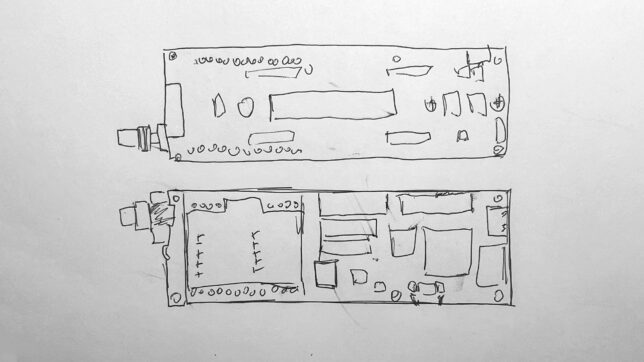
The node does not exist in isolation. It is embedded within an active urban network, operating continuously as part of a distributed communication system that extends across the city.
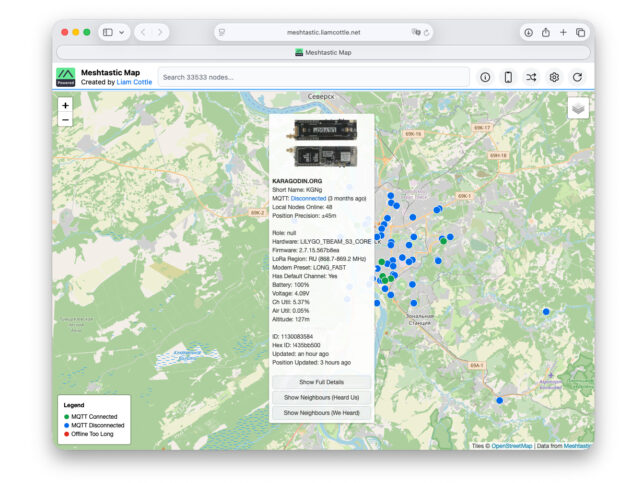
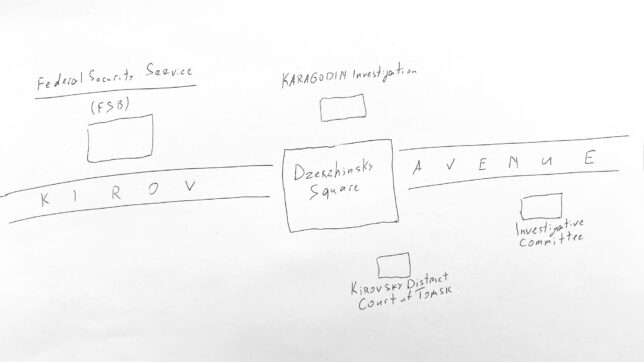
Positioned in the central district of Tomsk, it occupies a densely concentrated institutional field. Within a radius of several hundred meters are located the regional FSB headquarters, the court, the Investigative Committee, and the operational base of the KARAGODIN® Investigation itself. Centered around Dzerzhinsky Square, this area forms a convergence of administrative, judicial, and security structures. The configuration is not symbolic. It is spatially exact.
Within this field, the node functions as one of the central elements of the local mesh network. Its placement, coverage, and connectivity allow it to operate as a stable relay point, sustaining the flow of messages across the system. It does more than connect. Data passes through it, accumulates, and is redistributed. In this sense, it reinforces the internal structure of the network rather than simply participating in it.
The system has been active for several months. Since its deployment, it has operated continuously, without interruption, as part of the city’s communication environment. Its function is not hypothetical. It transmits, relays, and remains online.
This continuity defines its first condition: persistence.
At the same time, the node remains structurally discreet. Its physical location is not publicly disclosed and cannot be easily identified or isolated within the urban environment. Yet within the network, its position is explicit. It appears consistently and unambiguously as located above the FSB building, identifiable under the name KARAGODIN.ORG (KGNg).
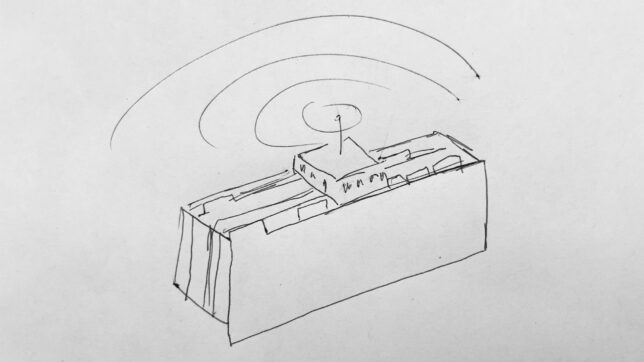
This dual condition — operational visibility and physical opacity — produces a structural asymmetry.
The node is visible where it cannot be removed, and unlocatable where it might otherwise be contained.
Its function extends beyond symbolic positioning. As part of a decentralized communication infrastructure, it contributes to the resilience of the network under conditions in which centralized systems become unstable. When mobile networks are restricted, platforms blocked, or internet access disrupted, mesh networks operate as supplementary channels. Under such conditions, the node does not alter its behavior. It continues to transmit.
This continuity defines a second order of function: infrastructural relevance.
The system does not require activation in response to crisis. It is already active.
At the same time, its communicative capacity remains only partially utilized. The node transmits and relays data within the network, but does not yet broadcast investigative material into the radio spectrum. This capacity exists in a latent state. The scripts are in place. Transmission can occur at any moment.
This suspension is not a limitation. It is a form of control.
The node operates fully within the system while withholding a function that would shift its role within it.
From within the network, it appears indistinguishable from other nodes. It participates, supports, and sustains communication. Yet its position — both spatially and symbolically — introduces another layer of meaning. It does not interrupt the system. It alters how the system can be read.
The test, then, is not confrontation, but endurance.
The node remains where it is, continues to function, and maintains its position within a field where presence is typically regulated by access. It neither exceeds the visibility afforded by the system nor withdraws from it. It persists.
Over time, this persistence produces its own effect. The node ceases to appear as an intervention. It becomes part of the environment in which it operates.
The Signal Remains Possible
The node transmits. It relays data continuously as part of the network. But its full capacity remains unused.
What it can transmit extends beyond ordinary communication. The system is capable of broadcasting fragments of investigative material into a shared radio channel: names of the executed, names of those who carried out the executions, institutional roles, archival references, reconstructed sequences of events. These transmissions may take the form of short messages — condensed, precise, expandable through attached links. A statement may consist of a single sentence, opening outward into a larger body of documentation.
The format is minimal. The implications are not.
The signal does not address a single recipient. It enters a shared frequency space, accessible to all nodes connected to the network. Every device within range becomes a potential point of reception. The message is not directed. It is distributed.
In this sense, transmission no longer operates as communication in the conventional sense, but as insertion. The signal does not seek an audience. It establishes presence within a medium that cannot be easily contained or selectively filtered.
What is transmitted is not the archive itself, but the investigation. The archive remains silent, contained within an institutional structure that regulates its exposure. The investigation, by contrast, moves across systems, translating material into forms capable of circulating beyond those constraints.
The node extends this movement into the radio-frequency domain.
Here, transmission acquires a different status. A signal, once emitted, does not return to a prior state. It propagates, is received, recorded, and potentially stored across multiple devices and systems. It becomes part of a distributed physical environment that exceeds the boundaries of any single institution. What was once contained as information becomes, in transmission, a material event.
For now, this capacity remains unactivated. The node does not broadcast investigative material into the open channel. It holds this function in reserve.
This suspension is deliberate.
The system accumulates presence without fully expressing it. It maintains a condition in which transmission can occur at any moment, but has not yet taken place. The archive remains closed. The node remains silent. Between them, another state emerges — not absence, but latency.
This latency is not neutral. It introduces a temporal dimension defined by potential rather than execution. The signal does not need to be continuous to be effective. Its possibility alone begins to alter the structure within which it exists.
At a certain point, transmission may occur. The conditions for this are not predefined. They arise within the same environment the node inhabits — shaped by pressure, restriction, or the narrowing of available channels.
When it happens, the signal will not announce itself as an event. It will appear as part of the network — indistinguishable in form, but different in content.
What matters is not only what is transmitted, but the fact that it can be.
The node has not yet spoken.
But it is no longer silent.
The Field Becomes Legible
The node does not introduce a new space. It alters the terms of an existing one.
The area in which it operates is not neutral. Centered around Dzerzhinsky Square in Tomsk, it forms a compact and highly structured field in which multiple institutional layers converge. Within a short walking distance stand the regional FSB headquarters, the court, the Investigative Committee, and the operational base of the KARAGODIN® Investigation. The arrangement is precise, but its significance exceeds geography.
The field is historical as much as it is administrative.
Dzerzhinsky Square bears the name of the founder of the Soviet security apparatus, from which successive institutions emerged: the Cheka, the NKVD, the KGB, and their contemporary continuation in the FSB. The surrounding district, marked by Kirov Street, traces another trajectory — one that leads into the onset of the Great Terror. These references are not symbolic overlays. They are embedded in the structure of the environment itself.
What appears as an urban configuration is, at the same time, a condensed topology of institutional continuity.
Within this field, the node does not produce a rupture. It takes a position among other positions. The archive, the court, the investigative apparatus, the ongoing investigation, and the communication node all operate within the same spatial and legal environment. They do not negate one another. They coexist.
What shifts is not the structure, but its legibility.
With the introduction of the node, a condition that would otherwise remain dispersed becomes perceptible. The field can be read as a single configuration, in which memory, enforcement, and inquiry are not separated, but aligned within a shared space.
This alignment is not fixed. It depends on position.
Even the most precise systems of spatial orientation contain a margin of error. A coordinate does not resolve to a single point, but to a small zone within which placement can shift. Within that margin, interpretation becomes unavoidable. A slight displacement — technical, perceptual, or conceptual — alters the frame through which the field is understood.
From one position, the point corresponds to the archive. From another, to the court. From another, to the investigative apparatus. From another, to the investigation itself. The distance is negligible. The difference is not.
The node operates within this condition as both a fixed coordinate and a shifting reference.
Its position is stable. Its interpretation is not.
What follows is not a transformation of the field, but a change in how it can be read. The space does not move. The relations within it become more difficult to disregard.
This visibility extends beyond the immediate environment. The node is registered within multiple systems of observation — those of network participants, regulatory frameworks, and institutional structures that monitor communication and frequency use. The field is not observed from a single point. It is continuously registered from multiple positions, each governed by its own logic.
Under these conditions, presence acquires a different quality. It is no longer defined solely by physical location or institutional access, but by the capacity to position oneself within overlapping systems of reference.
Nothing has been displaced.
And yet, the field is no longer the same.
Memory Becomes Infrastructure
What emerges from this configuration is not only a shift in method or position, but a redefinition of memory itself.
Within institutional frameworks, memory is typically understood as something stored, preserved, and accessed under regulated conditions. The archive embodies this model. It functions as a repository, but also as a mechanism of control — an interface through which access to the past is granted, delayed, or denied. What it contains is not simply historical material, but the conditions under which that material can be known.
In this sense, the archive does not merely hold memory. It governs it.
The investigation operates otherwise. It does not depend on storage alone. It proceeds through access, reconstruction, and rearticulation. Fragments are extracted, compared, and assembled into sequences that aim toward coherence. This process is not neutral. It is oriented toward accountability — toward producing forms of knowledge that can be recognized within legal frameworks, and, where that is not possible, within symbolic and cultural ones.
Memory, in this context, is not a static record. It is an operation.
It moves between states: from storage to access, from access to reconstruction, from reconstruction to transmission. Each stage depends on specific conditions. Where one is blocked, another emerges.
The node introduces a further transformation. It does not store memory in the conventional sense, nor does it resolve it into a fixed form. Instead, it establishes the conditions under which memory can persist as presence — distributed, transmissible, and operational.
In this configuration, memory is no longer tied to a single location or institution. It is not contained within the archive, even when it passes through it. It exists across systems, taking form through the infrastructures that allow it to circulate.
What appears as transmission is not only the movement of information. It is the continuation of memory in another medium.
Once emitted, a signal cannot return to its prior state. It propagates, is received, recorded, and potentially stored across multiple devices and systems. It becomes part of a distributed physical environment. In this transition, memory is no longer contained as information. It becomes an event.
Under these conditions, erasure becomes partial.
Material may still be restricted, delayed, or withheld within specific institutional contexts. But once it enters a distributed infrastructure, it cannot be fully withdrawn. It persists across nodes, devices, and recordings, forming patterns that resist containment within a single system of control.
This persistence is not only technical. It is structural.
As memory circulates, it produces points of concentration—sites where meaning accumulates and stabilizes. These sites are not defined solely by physical location, but by the density of relations that form around them. The investigation becomes such a point: a persistent attractor within a broader informational and social field.
Its presence does not depend on recognition. It is established through operation.
At the same time, the relation between memory and power does not dissolve. It remains a condition of tension. Institutions retain the capacity to regulate, delay, and withhold. But they no longer fully determine the forms through which memory can exist or circulate.
The conflict persists, but it is no longer confined to a single domain.
It extends across infrastructures.
Within this expanded field, memory is no longer oriented solely toward the past. It operates in the present and projects into the future. It draws from archival material without remaining bound to it. It becomes a mode of presence that connects temporal layers through ongoing processes of reconstruction and transmission.
What was once contained as record becomes active as relation.
Memory does not disappear under conditions of restriction. It changes its medium.
It becomes position, established through alignment within a field.
It becomes signal, carried across shared frequencies.
It becomes transmission, extending beyond the point of origin.
And in doing so, it becomes infrastructure.
Nothing Has Been Opened
Nothing has been opened.
The archive remains closed. Its procedures are intact. Its conditions unchanged. Access continues to be regulated, delayed, and withheld. The structure operates as designed.
And yet, it is no longer isolated.
A point has been established above it. A position that does not enter, but remains. A signal that does not interrupt, but persists. The archive is no longer the sole locus through which its contents can be oriented or approached. It is marked, aligned, and held within a wider field of reference that exceeds its internal logic.
What was once contained has become exposed — not through breach, but through position.
The surrounding space no longer resolves into a single institutional order. The configuration remains the same, but its coherence has shifted. The archive, the court, the investigative apparatus, the investigation, and the node now occupy a shared field in which no single point can fully determine the meaning of the others.
Authority remains, but it no longer resolves into a single center.
It is distributed across positions that coexist, overlap, and, at times, counterbalance one another. The structure of control persists, but it no longer defines the entirety of the field in which it operates.
The archive is not opened. It is no longer alone.
Its function as the primary interface to the past has been displaced — not removed, but relativized. It remains one system among others, no longer the only point through which memory can be accessed, organized, or asserted.
What has changed is not the archive itself, but the conditions under which it can be situated.
Position no longer belongs exclusively to the institution.
It can be established elsewhere, within infrastructures that operate alongside and beyond it.
Under these conditions, isolation becomes incomplete.
No system can fully enclose the field within which it exists. No structure can reduce memory to a single point of control without remainder. Alternative positions persist, whether recognized or not.
The field remains contested.
But it is no longer closed.
What persists, irreducibly, is presence.
Not as declaration. Not as intrusion.
Support the investigation with a donation — in ₽, $, €, or cryptocurrency — together, we can do more!