The KARAGODIN Investigation (KARAGODIN.ORG) is examined by historian Ivan Kurilla* as an example of ‘the past as action’ in his book The Battle for the Past: How Politics Rewrites History.
This text is a chapter from Ivan Kurilla’s book in which he discusses the Karagodin Investigation project. In the book, the project and its author, Denis Karagodin, are placed in the section ‘The Past as Action’. Kurilla shows that Denis Karagodin’s project has a deep system-forming, institutional character, with far-reaching institutional implications for Russian society.
The full text is published with the author’s permission.
The Battle for the Past
How Politics Rewrites History by Ivan Kurilla
The Battle for the Past
How Politics Rewrites History
HISTORY X: THE CASE OF DENIS KARAGODIN, OR "THE DIFFICULT PAST"

In June 2016, the media spread the story of Denis Karagodin, a graduate of Tomsk University, who was investigating the death of his great-grandfather Stepan—a victim of the Great Terror in early 1938. Stepan Karagodin was executed by the NKVD after being sentenced as part of a case against a "spy-sabotage group of 'Harbin residents and exiles from the Far Eastern Krai" and accused of being a "resident of the Japanese military intelligence." Denis demanded that the FSB investigate his great-grandfather's murder and identify those responsible for this crime.
Denis Karagodin raised the issue of state and individual responsibility for terror—not in terms of political accountability, as had been discussed since the 20th Congress of the Communist Party of the Soviet Union, but in the strictest legal sense. After all, the murder of an innocent person, no matter by whom, requires investigation and punishment of the perpe-trators. If the executioners were following orders, then the punishment should extend to the entire chain of command. And if too much time had passed and none of the perpetrators were still alive, a criminal investigation should at least establish their names and define their actions as crimes.
Russia never had a national reconciliation commission or a tribunal for the executioners. As Alexander Etkind demonstrated in his book Warped Mourning, the consequences of the Gulag have yet to be fully processed by Russian society and persist in culture, academia, interpersonal relation-ships, and people's interactions with the state2.

Denis Karagodin proposed his own way of confronting the past: a personal investigation and an individual legal claim concerning his great-grandfather's death. This was not just a matter of dry statistics but a concrete fate. Karagodin's website hosts dozens of archival documents identifying all the participants in his great-grandfather's case-from the General Secretary of the Communist Party to the individual executioners who pulled the trigger3.
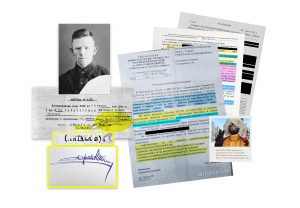
The son of an NKVD officer from Novosibirsk filed a police complaint against Denis Karagodin, the head of the investigative team of the Karagodin Investigation, accusing him of allegedly discrediting his father’s name.
The granddaughter of one of the people mentioned in Karagodin's findings, after discovering these documents, apologized to the descendants of those who had been repressed. Six years after the investigation began, in March 2021, the son of another NKVD officer, identified on Karagodin's site as an accomplice in the execution, filed a complaint against him with the Investigative Committee, accusing him of slandering his father and disclosing personal data. Society, too, was divided on the issue. Some saw the publication of these documents as a path to civil conflict between the descendants of victims and executioners, while others viewed it as the establishment of historical truth and a step toward civil reconciliation.
Mytbs and Documents

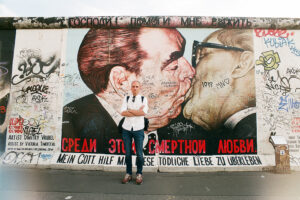
Denis Karagodin with the case file concerning the execution of Stepan Ivanovich Karagodin (and 35 other individuals), including the names of their executioners, at the execution trench on Kashtak Hill in Tomsk, November 16, 2016.
Denis Karagodin chose a legal approach to addressing the country's "difficult past." These chapters of Soviet history had been absent from public discourse until the 20th Congress of the Communist Party in 1956, when Khrushchev's speech on the cult of Stalin's personality opened the door for the narrative of innocent victims.
It took another fifteen years and a new period of political "freezing" for this narrative to evolve into a harsher one — describing the entire Soviet Union as a criminal state. In 1973, Alexander Solzhenitsyn published The Gulag Archipelago in the West, a "literary investigation" into the Soviet prison-camp system from 1918 to 1956. His book created a powerful image of repression as the foundation of the Soviet state. Since he relied primarily on personal experience and the testimonies of acquaintances, later critics accused him of exaggerating the number of victims of Red Terror. Nonetheless, his book provided an alternative historical narrative of the USSR, which continues to serve as a tool for political mobilization today. Even Solzhenitsyn's admirers acknowledge that The Gulag Archipelago is a literary, rather than strictly documentary, work.
Documentary research on Soviet repression became possible only during perestroika, when the historical and educational society Memorial was founded. Among its many activities, Memorial worked with archives to recover and publish the names of repression victims. In the late 1980s, destalinization unfolded in the media and among activists, though for many it appeared as little more than propaganda: journalists wrote about repression, Memorial gathered documents, but most citizens consumed this information passively until they felt they had "had enough" of it, as critics of continued discussion of the Soviet past now argue. It is no coincidence that Putin's regime banned Memorial in December 2021, on the eve of the invasion of Ukraine and the start of a new wave of political repression. In 2022, despite its forced closure in Russia, Memorial was awarded the Nobel Peace Prize.
KARAGODIN Investigation project – KARAGODIN.ORG
Karagodin's investigation is focused on restoring family history; in this context, destalinization could become a personal matter for hundreds of thousands of citizens. This powerful movement to reconstruct family history is fundamentally different from the intelligentsia's battles over historical interpretation in the media. The new memory is more complex and multilayered than any history textbook. There is an obvious parallel between Karagodin's case and the Immortal Regiment movement. In both cases, descendants turn to their family histories and integrate their ancestors into national history, viewing the past through their forebears' eyes.
If Solzhenitsyn's book can be said to have created an alternative myth that clashed with the official myth, then Karagodin's investigation represents a documentary, legal approach to engaging with the past.

The central entrance to the main building of the NKVD / KGB of the USSR and the FSB of Russia — Moscow, Russia.
It should be noted that supporters of the old myth continue to defend it. On the centenary of the Cheka-the Soviet secret police created in 1917 and the forerunner of the KGB-FSB Director Alexander Bortnikov gave an interview to Rossyskaya Gazeta in which he justified the extraordinary measures taken in the early years of Soviet power (without mentioning that these included extrajudicial executions and mass shootings), defended the "open trials" of the 1930s, and praised both Lavrentiy Beria and SMERSH. Beria, as Stalin's powerful security chief, oversaw the Great Terror and mass deportations, and later became notorious for his personal cruelty; SMERSH, created during World War II, was responsible for ruthless counterintelligence operations, arrests, and executions. The FSB itself is the modern successor of these Soviet institutions. Notably, Bortnikov began his interview with a statement about the need to debunk "many myths, often quite persistent," that had been created about the security services4. Unsurprisingly, his remarks provoked outrage among historians, who saw them as an attempt to whitewash mass repression and distort the past for political purposes5.
© Ivan Kurilla
References:
- 2 – Alexander Etkind, Warped Mourning: Stories of the Undead in the Land of the Unburied (Lincoln: University of Nebraska Press, 2013).
- 3 –"Rassledovanie Karagodina" [The Karagodin Investigation], https://karagodin.org/.
- 4 – V. A. Fronin, "FSB rasstavliaet aktsenty" [The FSB Sets the Accents], Rossiiskaia gazeta, December 20, 2017.
- 5. A. B. Suslov, "Aktsenty politikov kak vyzov dlia istorikov. Zametki na poliakh odnogo interv'iu" [Politicians' Accents as a Challenge for Historians: Notes on the Margins of One Interview], Istoricheskaia ekspertiza, no. 1 (14), 2018: 131-36.
Book Infromation:
Author: Ivan Kurilla
Title: The Battle for the Past: How Politics Rewrites History
Publisher: Springer Nature Singapore
Publication Date: October 25, 2025
Format: eBook
Language: English
Page Count: 143
ISBN: 9789819531929, 9819531926
Ограничения в РФ
* Согласно действующему законодательству РФ, с января 2025 года КУРИЛЛА Иван Иванович включен в список "иностранных агентов".
Подпишитесь на Telegram, MAX и YouTube.